
Whole Grain Wheat: A Healthier Alternative
By Sam
Resoundingly, the literature surrounding the health benefits of whole grain wheat suggest it is a healthier alternative to refined white flour.
A study by Borneo and Leon (2012) states that whole grains are beneficial for the human body for a variety of reasons. The increased level of dietary fibre present in whole wheat helps move potential toxins through the body, and helps increase good bacteria in the stomach, which in turn helps reduce the risks of chronic diseases such as hypertension, cardiovascular disease, type two diabetes, cancer and obesity.
But how?
In their study, Chris J. Seal et al. (2020) break this process down further. They state that:
“Whole grains are more complex than refined grains and are promoted as part of a healthy and sustainable diet mainly because the contribution of indigestible carbohydrates, and their co-passenger nutrients, is significantly higher”.
This means that the nutritional components of whole grain flour are more beneficial than those found in highly refined flours. Whole grain flour maintains the bran and the germ, which are often removed in the manufacturing process of refined flour. “The bran and germ contribute a range of nutrients including vitamins, minerals, phytochemicals (mostly polyphenolics and often referred to as “antioxidants”) and dietary fiber.”
Specifically, these can be listed as:
“Vitamin E, magnesium, pantothenic acid, phosphorus, thiamin, niacin and zinc. It is also a source of coenzyme Q10 (ubiquinone) and PABA (para-aminobenzoic acid) [42, 45] (Kumar et al., 2010).
Overall, the presence of higher levels of nutrients increases the value of the carbohydrate as a whole. The main benefits of whole grain flour, based on current research, are:
It takes longer to digest: this means that whole grain flour is considered low GI, and therefore does not contribute to high blood glucose concentrations (Chris J. Seal et al., 2020). This can help with type two diabetes management and weight management.
Higher in dietary fibre: this is due to the heightened presence of bran and germ (Chris J. Seal et al., 2020). Fibre is indigestible to humans, which means it travels through the body without being absorbed (Borneo & Leon, 2012). However, it is eaten by gut bacteria in the large intestine, meaning an increase in dietary fibre will increase good gut microflora, and a happy digestive tracht (Jefferson & Adolphus, 2019).
Co-passenger nutrients: these are the vitamins and minerals listed above, and can have a multitude of health benefits. As can be seen in the table below, whole wheat (whole meal) has higher levels of protein, fat (including essential fatty acids), vitamin E, riboflavin and folate. These nutrients help with hormonal regulation, nervous system regulation and overall health (see Kumar et al., 2010 (link).
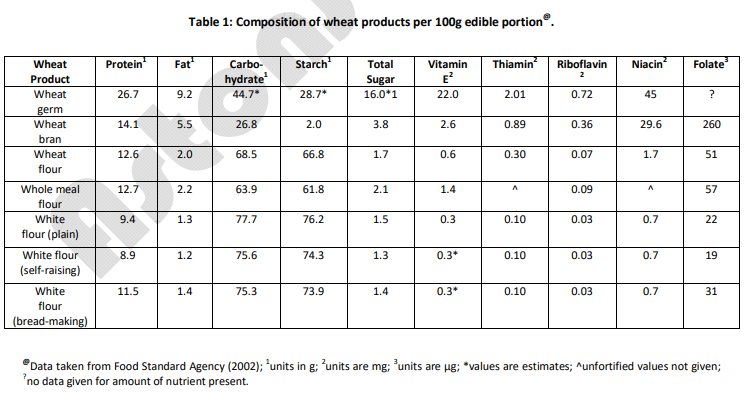
(Kumar et al., 2010)
Scientists are continuing to study the impact of whole grain flour on human health, and benefits it has on conditions such as inflammation and chronic diseases. Still, the overwhelming recommendation from the research above is that whole grain flour is much more beneficial to health than refined flour, and is a highly endorsed addition to the modern diet.
References
Borneo, Rafael, and Alberto Edel León. "Whole grain cereals: functional components and health benefits." Food & function 3, no. 2 (2012): 110-119.
Jefferson A and Adolphus K (2019) The Effects of Intact Cereal Grain Fibers, Including Wheat Bran on the Gut Microbiota Composition of Healthy Adults: A Systematic Review. Front. Nutr. 6:33. doi: 10.3389/fnut.2019.00033
Keirns, Bryant H., Kendall L. Anderson, Babajide A. Ojo, Karley F. Washburn, Guadalupe Davila El-Rassi, Stan A. Lightfoot, Brett F. Carver, Edralin A. Lucas, and Brenda J. Smith. "A comparative study of modern and heirloom wheat on indicators of gastrointestinal health." Journal of agricultural and food chemistry 67, no. 51 (2019): 14027-14037.
Kumar, Pawan, R. K. Yadava, Babita Gollen, Sandeep Kumar, Ravi Kant Verma, and Sanjay Yadav. "Nutritional contents and medicinal properties of wheat: a review." Life Sciences and Medicine Research 22, no. 1 (2011): 1-10.
Okarter, Neal, and Rui Hai Liu. "Health benefits of whole grain phytochemicals." Critical reviews in food science and nutrition 50, no. 3 (2010): 193-208.
Seal, Chris J., Christophe M. Courtin, Koen Venema, and Jan De Vries. "Health benefits of whole grain: Effects on dietary carbohydrate quality, the gut microbiome, and consequences of processing." Comprehensive Reviews in Food Science and Food Safety 20, no. 3 (2021): 2742-2768.
